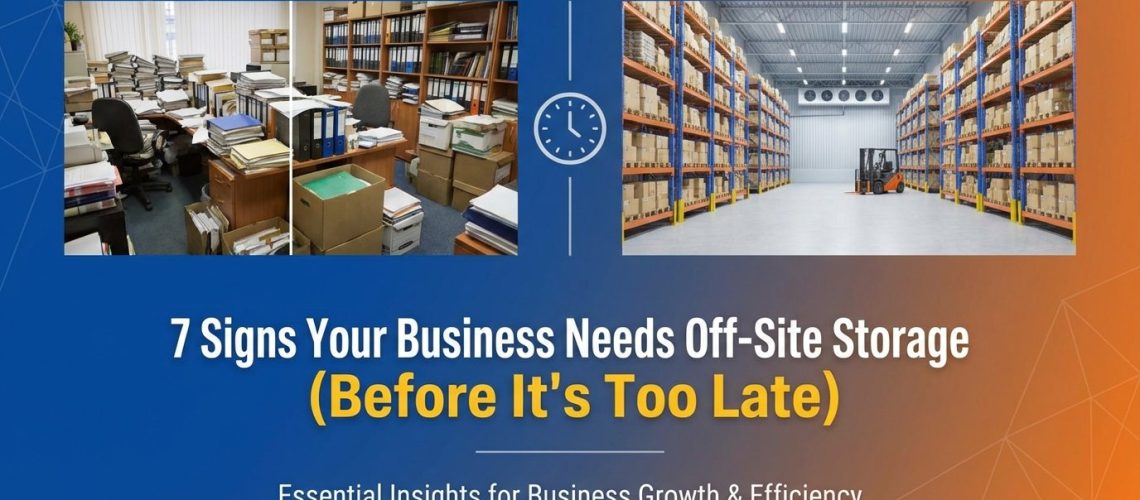
7 Signs Your Business Needs Off-Site Storage (Before It’s Too Late)
Every successful business faces a predictable problem: growth creates clutter. What starts as a few extra boxes in the corner can quickly spiral into a maze of inventory blocking emergency exits, files consuming your conference room, and equipment stacked so high that finding anything becomes a scavenger hunt. If you’re constantly shuffling items to make workspace, you’re not just dealing with an organizational issue—you’re facing a serious drain on productivity and profitability.
The challenge for small to medium-sized businesses is knowing when temporary clutter has crossed the line into a legitimate need for business storage solutions. Waiting too long can result in lost sales, employee frustration, safety violations, and missed opportunities. Let’s examine the clear warning signs that your business has outgrown its current space and needs to explore warehouse storage alternatives before the situation impacts your bottom line.
1. You’re Paying for Space You Can’t Actually Use

Walk through your facility right now. How much of your expensive commercial square footage is occupied by items that haven’t moved in months? Many business owners realize they’re paying premium rates for retail or office space that’s essentially functioning as a storage unit.
Calculate the cost per square foot of your current location, then multiply that by the space consumed by stored inventory, archived files, seasonal equipment, or excess furniture. That number represents money you’re throwing away every single month. Commercial storage offers a fraction of that cost while freeing your valuable space for revenue-generating activities.
This becomes especially problematic for businesses in high-rent districts. If you’re operating in downtown areas or premium commercial zones, storing old records or off-season inventory in that space might be costing you $30-50 per square foot annually when you could be using those same square feet for customer service areas, additional workstations, or product displays that actually generate income.
2. Employees Are Wasting Time Searching for Items
When your team spends 15 minutes hunting for a specific product, document, or tool, that’s not just frustrating—it’s expensive. Multiply those lost minutes across your entire staff and you’re looking at hours of wasted labor every week.
Disorganized inventory storage creates a ripple effect throughout your operations. Customer service suffers when you can’t quickly locate items. Projects stall when employees can’t find the materials they need. Morale declines when workers feel like they’re fighting against their environment instead of focusing on meaningful work.
Off-site storage paired with a proper inventory management system allows you to know exactly where everything is located. Items you need daily stay on-site. Everything else moves to accessible commercial storage where it’s organized, cataloged, and available when needed without cluttering your workspace. Ground-level accessibility makes retrieving stored items quick and straightforward, eliminating the hassle of navigating multi-story facilities or dealing with elevators when you need something in a hurry.
3. You’re Turning Down Business Due to Lack of Space
This is the most expensive sign of all. If you’ve ever had to decline a large order because you don’t have room to store the inventory, or if you’ve passed on a lucrative project because you lack space for the necessary equipment, you’re not just losing current revenue—you’re potentially losing future business from those disappointed clients.
Restaurants expanding their catering services need room for additional equipment and supplies. Contractors taking on bigger projects require space for materials and tools. Retailers preparing for seasonal rushes must stock inventory in advance. When your physical limitations prevent you from capitalizing on opportunities, you need small business storage that can scale with your ambitions.
The ability to accept larger orders or take on additional projects often means the difference between steady growth and stagnation. Warehouse storage alternatives provide the flexibility to say “yes” to opportunities without committing to expensive facility expansions or long-term commercial leases you might not need once the project concludes.
4. Safety Hazards and Code Violations Are Appearing
Stacked boxes blocking fire exits. Equipment creating trip hazards in walkways. Inventory piled near electrical panels or emergency equipment. These aren’t just organizational problems—they’re serious safety violations that could result in fines, increased insurance premiums, or worse, actual injuries.
OSHA regulations require clear pathways, accessible emergency equipment, and proper storage of materials. When you’re cramming too much into too little space, compliance becomes nearly impossible. A single workplace injury due to cluttered conditions can result in workers’ compensation claims, potential lawsuits, and damaged employee trust.
Beyond regulatory compliance, overcrowded workspaces simply aren’t conducive to productivity. Employees working in cramped, chaotic environments experience higher stress levels and lower job satisfaction. Creating a clean, organized workspace by moving excess items to business storage solutions demonstrates that you value both safety and employee wellbeing.
5. You’re Using a “Rotation System” That Nobody Follows
Many businesses attempt to manage limited space by implementing complex rotation systems—bringing in seasonal inventory, moving out old stock, constantly shuffling items from one corner to another. In theory, these systems work beautifully. In practice, they rarely survive contact with the reality of daily operations.
When your rotation system requires an instruction manual, when only one person truly understands where everything goes, or when you find yourself regularly recreating the system because it keeps breaking down, you’ve outgrown DIY space management solutions. Professional inventory storage provides consistent, reliable organization without requiring your staff to become logistics experts.
The mental bandwidth consumed by constantly managing and reorganizing limited space is bandwidth your team can’t dedicate to core business activities. Decision fatigue is real, and forcing your employees to make constant spatial judgment calls (“Does this go here or there? Should we move this to make room for that?”) depletes the mental energy they need for actual productive work.
6. You’re Considering Expensive Facility Expansion
Before signing a lease on additional square footage or committing to a building expansion, run the numbers on commercial storage alternatives. Expanding your facility is expensive—not just the obvious costs of rent or construction, but the hidden expenses of additional utilities, insurance, maintenance, and property taxes.
For many businesses, the smarter solution is keeping your primary location focused on operations while utilizing off-site storage for inventory, equipment, archived records, and seasonal items. This hybrid approach gives you the space you need at a fraction of the cost of facility expansion.
Consider a retail business contemplating doubling their footprint to accommodate back-stock inventory. Instead of paying for twice the square footage at retail rates, they could maintain their current customer-facing space while storing excess inventory in commercial storage at warehouse rates. The savings are substantial, and the flexibility is invaluable if business needs change.
7. Your Inventory Turnover Has Changed
When you first established your business, you might have needed everything on-site because inventory moved quickly. As your business evolves, some items turn over rapidly while others sit for months. This creates an inefficient use of your valuable floor space.
Smart small business storage strategies segregate inventory based on turnover rates. Fast-moving items stay on-site where they’re immediately accessible. Slower-moving inventory, backup stock, and seasonal items move to off-site storage. This approach optimizes your primary location for the items that drive daily revenue while ensuring you still have access to everything else when needed.
For businesses operating in South Florida and the Treasure Coast, this strategy becomes even more critical during peak seasons. Tourist-dependent businesses experience dramatic fluctuations in inventory needs. Rather than maintaining year-round space for peak-season stock, warehouse storage alternatives allow you to scale your physical footprint up and down as demand requires.
Making the Transition to Off-Site Storage
Recognizing the need for business storage solutions is the first step. The second is choosing a provider that understands commercial requirements. Unlike residential storage, business storage demands reliable access, security for valuable inventory or equipment, and protection from environmental factors that can damage goods.
Companies with logistics experience bring operational expertise that matters when you’re storing business-critical items. Armellini Logistics has been serving Florida businesses for over 70 years, bringing that depth of knowledge to modern mobile storage solutions that combine security, accessibility, and convenience.
The process is straightforward: storage units are delivered directly to your location, you load them at ground level on your schedule, and they’re transported to a secure facility or kept on-site as your needs dictate. When you need access to stored items, retrieval is simple and quick—no navigating vast warehouse complexes or waiting for third-party coordination.
The Cost of Waiting
Every day you operate in cramped, inefficient conditions costs money. Lost productivity, missed opportunities, employee frustration, safety risks, and wasted premium square footage all chip away at profitability. The businesses that thrive aren’t necessarily the ones with the biggest facilities—they’re the ones that use their space most strategically.
Off-site storage isn’t an admission that your business is struggling; it’s a strategic decision that successful companies make to optimize operations and control costs. The question isn’t whether you can afford business storage solutions—it’s whether you can afford to keep operating without them.
If you recognized your business in three or more of these warning signs, the time to act is now. Don’t wait until a safety inspector issues a citation, a valuable employee quits due to workspace frustration, or you lose a major contract because you couldn’t accommodate the inventory. Evaluate your true storage needs, calculate what inefficient space usage is actually costing you, and explore commercial storage options that give your business room to breathe and grow.
Ready to reclaim your workspace and boost operational efficiency? Contact Dash Mobile Storage to discuss flexible business storage solutions tailored to your specific needs. With convenient locations serving South Florida and the Treasure Coast, ground-level accessibility, and the backing of 70+ years of logistics expertise, we help businesses of all sizes optimize their operations without the expense of facility expansion.